

The Thematic Pulse #3
The themes I track, in one place: what moved over the past month, the events behind it, and what's worth noting.

Welcome to the third edition, and a quick hello to those who’ve joined since the last one. It was supposed to be a quiet month. The World Cup has wrapped up, a good part of Europe preparing to go away for the summer, and markets have had that thin, mid-holiday feel where it looks like nothing much is happening.
On the contrary. While most people were looking the other way, a hedge fund called Situational Awareness, running around $20bn, was liquidated in a matter of days, its entire public book sold off in a single block trade. The S&P 500 at the time sat barely two to three percent below its all-time high. A fund collapsing while the index is near a record sounds like it shouldn’t be possible, and the reason it happened tells you what was really going on under the surface. So let’s get into it.
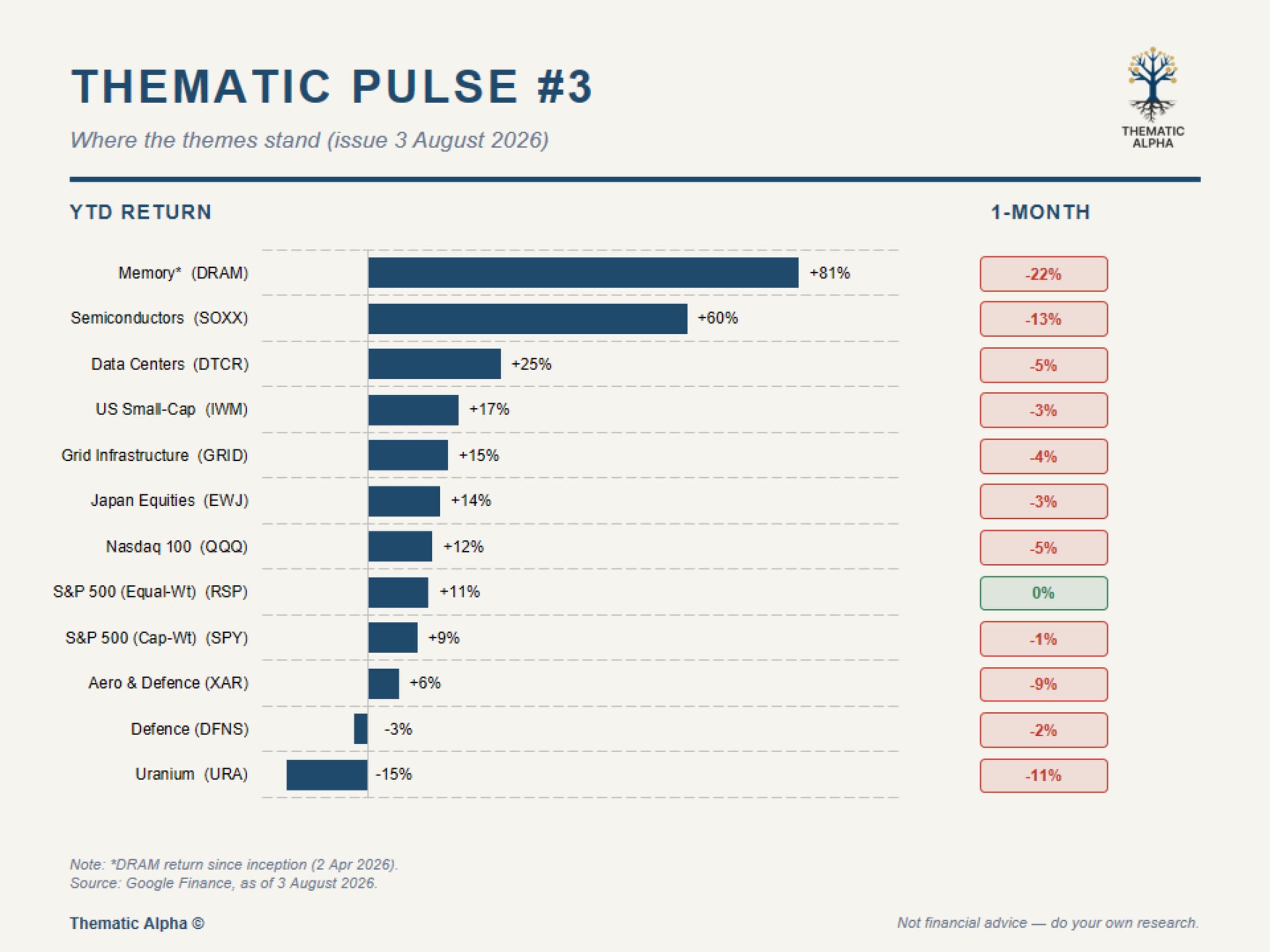
Same idea as before: one board, with year-to-date and one-month performance side by side, for the structural themes I follow. Most I hold with a longer-term view; a few are on watch rather than in the portfolio. It’s a tracking tool, not a call to action. A month of price movement is mostly noise, and the point is to keep the bigger picture in view through it.
This month we’ll walk through three events that shaped the board, the sell-off in chips and memory, the Fed’s July rate decision, and that fund liquidation, then go theme by theme.
The month in the world
Start with the board, because it looks worse than the month actually was. Almost every line on it is red. It was a red month for the AI trade above all, with the chip and memory names leading the fall and the Nasdaq finishing lower, while even the steadier themes we track closed down. And yet the S&P 500 itself sits barely below its all-time high, and the equal-weighted version of it made a new record. That gap, a board full of red while the broad index holds near a high, is the month in one picture. Underneath it, the market ran one of its sharpest rotations in years: out of the crowded AI winners of the first half, and into the parts of the market everyone had ignored. J.P. Morgan called it “a repricing of AI economics.” Investors have not stopped believing AI will reshape the economy; they have stopped rewarding the spending on its own, and started asking to see it turn into returns. Once earnings season began, that showed up in the tape: some companies beat expectations and their stocks fell anyway, a sign of just how high the bar had become.
The chip and memory sell-off.
The month’s biggest move, and a strange one, because there were actually two separate scares. In mid-July a cheaper Chinese AI model, Moonshot’s Kimi K3, set off a familiar “DeepSeek again” reaction, and chips sold off worldwide on the worry that cheaper AI means less need for expensive hardware. Within days the market talked itself round: a model that large actually needs more memory to run, not less, and the read flipped to bullish for the memory names. Then, at the end of the month, the real drop came, and it was a different story. A Chinese memory maker, CXMT, exploded higher on its Shanghai debut and stoked fears of DRAM oversupply, landing the same week as reports that China is making faster progress in chipmaking equipment. That was the trigger. The accelerant was leverage, in Korea specifically. Retail investors had crowded into a single product, a 2x leveraged ETF tracking SK Hynix that had already lost the bulk of its value from its June peak; as the shares fell, forced selling and margin calls fed on themselves, the Korean market hit circuit breakers on two consecutive days for the first time in its history, and the finance minister ended up apologising in parliament for letting the products launch. The timing was cruel: in the same week, SK Hynix and Samsung both reported record quarters, revenue up around 250% at SK Hynix and 350% at Samsung’s chip division, and the stocks fell regardless. The tell worth keeping: the companies posted records, and it was positioning, not demand, that broke.
The Fed held, and still managed to sound hawkish.
This was Kevin Warsh’s second meeting as chair. The Fed left rates at a target range of 3.50% to 3.75%, as expected. The vote was 9 to 3, and all three dissenters wanted a hike, not a cut. That is a lot of dissent. Most meetings pass with the committee lined up behind the chair, so three members breaking the same way, all toward tighter policy, is the clearest sign yet that this Fed is genuinely close to hiking. Warsh gave markets almost no steer on where policy goes next, and refused to call the hold a pause, describing it instead as “a rigorous review of the economic situation.” Markets took the hawkish read: the long end of the bond market sold off hard, the 30-year yield reaching its highest since 2007, and futures now put the odds of a September hike at around 60%. He also singled out the surge in high-tech capex as remarkable. Apollo’s Torsten Slok added a useful piece of colour, noting that long rates rose more after the press conference than during it; his read is that with no forward guidance, the market grasps the Fed’s 2% goal but not how it plans to get there, and that uncertainty about the route is what pushes yields up. The way I think about it: if the data forces the market to price a hike in properly, expect another leg of risk-off in the rate-sensitive corners, the long-duration themes on this board included. But over a longer horizon I lean the other way, because the US now spends more servicing its debt than it does on defence, with net interest past $1tn a year and at a record share of the economy, and that bill argues against keeping rates high for years. Strategists have a name for the dynamic now, fiscal dominance. The Fed’s mandate is still inflation and jobs, not the Treasury’s interest bill, but it is why I doubt rates stay this high for as long as today’s hawkish tone implies.
And the hedge fund that got liquidated.
Back to that hedge fund. It was run by Leopold Aschenbrenner, a 25-year-old former OpenAI researcher, and it had built a concentrated, highly leveraged bet on exactly the AI-infrastructure names, power, storage, compute, that were now selling off: roughly three-quarters of the book in a handful of positions, run at around four times leverage. When the chips fell, the prime brokers made their margin calls, and with positions that large in names that illiquid there was no quiet way out. The whole public book was sold in a single block to Citadel, which stepped in as the buyer of the wreckage rather than any kind of rescuer. Here is the part worth sitting with. The public portfolio was down around two-thirds in the month, yet the fund was still up on the year, partly because it had entered July up several hundred percent, and partly because its biggest position, a roughly $5bn private stake in Anthropic, sat untouched by the rout. Aschenbrenner’s line to investors was simply “We let you down this month.” The thesis was not the problem. The leverage was. It is the cleanest illustration I can give of a rule this letter keeps coming back to: pick the themes, but size them so you can sit through the noise, because leverage is what turns a bad month into a permanent one. A fund can be right about AI and still not survive being right.
Underneath all of it, a familiar backdrop. The US and Iran clashed again over the Strait of Hormuz during the month, sending oil sharply higher for a spell, which is part of what keeps the Fed cautious on inflation. Different order, different magnitude, but a cast of worries we have seen before.
What moved across the themes
One read on the month as a whole before the theme-by-theme. This was a rotation, not a panic. Money left the crowded, expensive corners of the AI trade and went looking for the cheaper, more cash-generative parts of the market, while the broad index barely budged. It helps to be clear about what actually drove the falls, because it was not one thing: excess leverage in the memory names, a fresh scare about cheaper Chinese competition, and plain sell-the-news on results that were often very good. None of that is the same as the story breaking. The thing to watch through a stretch like this is not the red on the screen but whether it actually breaks a thesis, or is just the market repricing who gets rewarded. This month it was mostly the latter.
Compute and memory. The fundamentals never cracked; the stocks did. Memory was the board’s big faller, yet the numbers underneath it went the other way. Samsung called the memory market undersupplied into 2027 and 2028; SK Hynix said the tightness is unlikely to ease soon, with its president noting it looks “difficult for the supply-demand balance to improve meaningfully in the near term.” Samsung’s memory chief guided high-bandwidth memory sales up “more than three-fold quarter-over-quarter” for the current quarter. Both are now locking the majority of their capacity, on the order of 60% to 70%, into long-term agreements, which is not what you do into collapsing demand. So the sell-off was about crowded positioning and forced selling, not a broken theme. Most large semiconductor names (Nvidia, AMD and Broadcom, etc.) have not reported yet, it’s worth watching their results and the respective market’s reaction.
Grid and power. This is where the beats got paid. If you want evidence that the market rewarded proof of returns and punished promises, put memory next to the grid names. The picks-and-shovels of electrification mostly beat expectations and raised guidance, and their shares mostly rose on it. Eaton posted record revenue, raised its outlook, and its chief executive put the demand in a single number, describing a US data-centre order book of “307 gigawatts, or 15 years of backlog at 2025 build rates.” Quanta Services delivered a large beat on a record backlog and climbed sharply; Schneider Electric, the largest holding in the theme, beat and raised guidance, with the stock rising too. The split within the theme is the tell, and it was a rational one. The steady electrical-equipment names delivered and got paid for it. The two that had run the hardest, Vertiv and GE Vernova, each up around 75% on the year going in, actually stumbled: Vertiv came in light on sales, GE Vernova on profit, and priced for perfection as they were, the market punished them, Vertiv falling about 17% in a day. That is the opposite of the memory tape. Here the market paid for delivery and docked the misses, rather than dumping records on forced selling. Grid is the calmer way to own the AI build-out, and this month it behaved like it.
The hyperscalers. Everyone spent more, the market paid only some of them. Worth singling these out since they deserve a separate theme (and contribute to a large %-age of S&P / QQQ). The companies writing the cheques for all of this, Microsoft, Amazon, Alphabet and Meta, reported in the last week of July, and every one raised its AI spending plans for the year, the four now pointing to something like $600bn between them. What separated the winners from the losers was not the spending, it was whether they could show it turning into revenue. Microsoft and Amazon could: a committed cloud backlog of around $680bn at Microsoft and $500bn at Amazon, cloud growth reaccelerating, and both stocks jumped around 15%. Meta could not, at least not in the same currency, since it monetises through its own advertising rather than renting capacity out, so it had no order book to point to, missed on earnings, and fell. Alphabet sat in between, with a backlog of its own above $500bn, but the market still marked it down for lifting its capex bill. Goldman put a number on the tension: the hyperscalers are now spending close to all of their operating cash flow on AI, which is why buybacks are being cut, and whether that continues depends on whether the spending proves profitable. Or, as J.P. Morgan framed it, the market is now rewarding whoever is upgrading revenues, not whoever is merely upgrading capex plans.
Uranium and nuclear. A scary headline that turns bullish under the hood. Uranium had another soft month on the board, and part of that is simply rates: it is one of the longest-duration plays I track, capital-heavy and years from payoff, so a “higher for longer” Fed weighs on it more than most (especially on the ETF constituents with more revenue in forecast period). The month’s event was Cameco’s result (almost 20% of URA as the major Western producer), and the headline looked ugly, net earnings down around 90% on the year. But almost all of that came from a single non-cash line, its stake in Westinghouse, swinging against a one-off in the year-ago quarter; the uranium business itself was fine, realised prices up and full-year guidance held. The market saw through it, the stock actually rising on results day, and the consensus stayed a Buy and still implies something like 50% upside from here. On the thesis, management was bullish. The chief executive pointed to “durable demand growth” behind uranium’s long-term structural drivers, while his president and chief operating officer noted the long-term contract price had climbed back into the mid-90s a pound and looked headed for three figures, even on very little new demand. That last part is the one that matters, because the soft spot price the equities react to is not the price Cameco actually sells at. Utilities fuel reactors on multi-year contracts struck well above spot, and Cameco is holding out for those, unwilling to sign its pounds away cheaply while the tape is soft. The screen is red; the case is intact. We’ll pick this apart properly in the next deep dive.
Defence and space. A tale of two continents. The theme split cleanly this month. In the US, the big primes reported strong quarters and were rewarded, with Lockheed and RTX both beating, raising, and rising on record backlogs as Pentagon restocking runs on. In Europe, the politics pulled the other way. Two flagship Franco-German programmes retrenched in quick succession, the next-generation fighter effort and, weeks later, the joint battle-tank project, both scaled back amid disputes over workshare. Even so, the spending only gets bigger: NATO’s European members and Canada are now on track for well over $600bn this year, and Germany keeps lifting its budget. Rheinmetall underlined the split, reporting a record order backlog above €80bn while flagging sharply negative cash flow for the quarter. If you think the world is drifting away from globalisation rather than back toward it, strategic and sovereign capabilities stay a structural, multi-year hold, whatever the month-to-month price action.
Japan. Two stories, and it’s worth keeping them apart. The equity case and the currency are pulling in different directions right now, and conflating them is where people get Japan wrong. The structural story keeps strengthening. Goldman’s latest work on Japan, a piece it calls “Japan’s Strategic Awakening,” frames it as a genuine inflection rather than the usual single-narrative cycle: defence spending has roughly doubled to 2% of GDP, wage growth is finally credible, and the central bank has rates back at around 1%, which restores a normal cost of capital and forces companies to justify holding idle cash. Governance reform has moved from aspiration to catalyst, with record buybacks, rising shareholder activism, and the busiest market for corporate deals in years. On top sits the new administration’s supply-side push, a strategic-investment plan running into the hundreds of trillions of yen over the next decade and more across sectors like AI, energy and shipbuilding. That is the part I own.
The currency is a separate, near-term matter, and this month it did something notable. The yen had slid to roughly a forty-year low against the dollar, and the interesting thing is what finally turned it. Japan has intervened on its own many times, most recently at record scale this spring, and each time the bounce faded and the yen kept sliding. A solo move late in July again lifted it a few percent, then stalled within a day. What made this one stick was the United States stepping in alongside Tokyo and actually buying yen, reportedly its first time doing so since 2011. This time the bounce held. It is early, and I would not call the reversal durable yet, but the lesson is clear enough: the solo interventions did not work, and it took Washington joining in to change the tape. For the index, a historically weak yen has been a tailwind for exporters, so the real decision is your currency exposure, not the equity thesis. You can see how much that matters in the two versions of the Japan ETF: over the past year (12 months) the unhedged one returned about 23%, the hedged version about 36%, and that gap, the yen quietly clipping the unhedged return, is a choice that compounds.
Breadth. The quiet winner, again. The lazy read is a narrow, mega-cap market. The board says otherwise. This month the equal-weighted S&P was flat and yet still touched a new record, while the cap-weighted index barely moved and the Nasdaq fell, a clean rotation out of the biggest AI names and into the rest. The honest caveat is that it did not broaden all the way down: small caps lagged this month, so the “small-caps are leading” line, true year-to-date, did not hold in July specifically. But the broadening is increasingly backed by fundamentals, not just hope: Goldman lifted its 2026 earnings-growth call for the S&P to around 17%, and stressed it is not only the mega-caps, the other 493 companies are growing earnings at double digits too, well above the long-run trend and with margins still widening. Leadership sitting with the median stock rather than a handful of giants is a healthier backdrop, not a more fragile one, and it is worth remembering whenever the bubble debate flares up.
The one-line read
The board is mostly red this month, but the fundamentals underneath it are not. Records got sold, some of them after genuinely strong earnings, a fund got liquidated, and the softest themes each had a clear near-term reason sitting on top of a case that is still intact. What changed this month was not whether the AI build-out is real, but how the market wants to be paid for it: less for the spending, more for the proof it turns into returns. As one house put it, the disappointments came not because the fundamentals were bad, but because expectations had become unbeatable. The market is repricing the trade, not walking away from it. The job through a month like this is the dull one: separate the noise from the signal, and keep your positions sized so the noise can’t force your hand.
What’s worth watching from here
The chip and memory reports still to come. The memory names have largely reported, but the two that swing this whole complex, Nvidia, AMD and Broadcom, do not report until later this month, and after a month like this the reaction will matter as much as the numbers. The clearest sign the reset is over will be strong results that are actually rewarded again.
The Fed, 15 and 16 September. With futures putting a hike at around 60%, this is the meeting the whole hold-versus-hike argument points to. The mid-August inflation print is the number most likely to tip it either way.
Coming up: the next deep dive turns to nuclear. After a month where uranium’s screen looked ugly and its case looked better the closer you looked, it feels like the right moment to walk the whole value chain, from the fuel to the reactors to the equipment, and lay out where the real opportunities and risks sit. If you’ve been waiting for the uranium piece, it’s next.
If there’s a theme you’d like me to track or write about, send me a message. And if you know someone who’d enjoy this kind of thematic work, sharing the newsletter is the main way it grows.
Have a good week, all.
Best, Oliver.
Disclaimer: This is not investment advice, and you should do your own research. This reflects my own thinking; individual circumstances differ.