

The Thematic Pulse #2
The themes I track, in one place: what moved over the past month, the events behind it, and what's worth noting.

Welcome to the second edition, and a quick hello to the many of you who’ve joined since the last one. Hope you’re all enjoying the summer (despite all the heat Europe is facing) and looking forward to the upcoming World Cup play-offs, Wimbledon and hopefully some well-deserved time off. Let’s get to it.
Same idea as before: one board, with year-to-date and one-month performance side by side, for the structural themes I follow. Most I hold with a longer-term view; a few are on watch rather than in the portfolio. It’s a tracking tool, not a call to action. A month of price movement is mostly noise, and the point is to keep the bigger picture in view through it.
One thing is different this time. We’ve crossed the middle of the year, so I’ve added an extra section up top, built around BlackRock’s latest quarterly outlook (issued just last week): what one of the largest managers in the world is seeing, and what it actually means for the themes on this board.
The month in the world
Before we move into the scorecard, let’s look at the key events of the past month and why they matter on a broader scale. A war in the Middle East flared and then cooled into a ceasefire, sending oil sharply up and then back down. That upward oil move pushed inflation higher across most of the developed world, which in turn pushed central banks to hold or hike rather than cut. The Fed got a new chair, and markets started to price a more hawkish scenario, at least over the medium term. On the IPO front, we got the largest offering in history, SpaceX, even as another AI giant, OpenAI, hinted it might push its own listing to 2027. And underneath all of it sat the question that won’t go away (the one the doomsday narrators love): is AI a bubble?
Oil spiked on the war, then fell all the way back.
The conflict between Israel and Iran escalated in early June, before the two sides agreed to a ceasefire framework mid-month (which, hopefully, holds), a 60-day window to negotiate, with the US adding a 60-day waiver on Iranian oil. Brent, which had spiked hard, fell back to the high-$70s, its lowest since March. Within two days of the framework the major banks were already cutting their oil forecasts: Goldman and Morgan Stanley both took their fourth-quarter Brent call to $80, and Citi to $70, though some may hold a higher number for now, or wait to revise until the Strait of Hormuz is clearly out of danger and no further escalation follows. It’s worth flagging that the truce is fragile and has wobbled once or twice, but the direction over the month was toward calm.
Central banks turned hawkish, and the Fed got a new chair.
The major central banks all leaned the same way at once: the European Central Bank raised for the first time since 2023, and the Bank of Japan went to 1.00%, its highest since 1995. But the one that mattered most was the US, because this was the first meeting under a new chair. Kevin Warsh has taken over from Jerome Powell. Two things came out of Warsh’s debut. First, the Fed’s own rate projections moved up: the median policymaker now expects no cut at all this year and a higher path from here, with half the committee pencilling in a hike. Second, and the part that drew the most attention, Warsh stripped out forward guidance almost entirely, cutting the policy statement to barely a hundred words and making clear that markets should read the data themselves rather than be steered by the Fed. It’s a deliberate break from the Powell era: less hand-holding, more volatility around each data point.
There’s a counterintuitive twist on the oil move worth spelling out. You’d think oil falling from $120 toward $80 takes pressure off inflation and clears the way for cuts. Apollo’s Torsten Slok argues close to the opposite: cheaper energy acts like a tax cut into an already-hot economy, lifting demand and, with it, inflation. Pair that with a Fed that has stopped promising cuts, and the prevailing read going into the second half is “higher for longer”, with Goldman now seeing no cut until 2027. The path of least resistance for rates has stopped pointing down.
SpaceX, and two more giant IPOs worth watching.
SpaceX listed in mid-June at $135 a share, the biggest IPO on record. The hype was enormous, and at first it delivered: the stock popped on debut and ran up to around $200 in four days, before fading just as fast back to the $150-160 range, only a little above where it priced. That’s roughly the behaviour you’d expect for an offering of this size: with heavy retail participation and a wave of lock-ups due to expire over the coming months, some cooling-off was always likely. Does it deserve a place in a longer-term portfolio? I’d lean yes, if you genuinely believe in Elon’s entrepreneurial track record and you’re looking out over years rather than quarters; Tesla is the obvious precedent.
Two more giants are queued behind it: Anthropic is expected to list around October, and OpenAI has reportedly pushed its own debut back to 2027 (per the New York Times). Why give IPOs this much attention? Because a wave of jumbo listings has a long history of clustering near cyclical highs, when sellers rush to cash in rich valuations: Blackstone went public months before the 2007 top, Glencore at the peak of the commodity cycle, Saudi Aramco weeks before the 2020 crash, and the record 2021 class right before the 2022 bear market. These three are a sharper signal than most, because they are the AI ecosystem. How they’re received, and whether the likes of OpenAI and Anthropic can justify their valuations, will say a lot about whether the AI trade has further to run or is getting ahead of itself. Worth watching, not as a timing tool, but as a tell.
And the question under all of it: is AI a bubble?
Markets near records always invite it, and nobody answers it well in advance. Three things are worth holding onto. First, on sentiment: Bank of America’s June fund-manager survey put the AI rally in its “boom” phase, not “euphoria”, with 56% choosing boom against just 21% for euphoria, even as a record 80% called long semiconductors the most crowded trade on the Street. Boom isn’t the same as bubble. Second, on whether the spending pays off. Technology is now a record share of all S&P 500 capital spending, concentrated in a handful of giants, and the fair question is the return on it. The honest tension is that for the median company the AI payoff might still be hard to find (integration takes time to catch up), which leaves an opening for cheaper Chinese and open-source models to undercut the expensive American ones. Two things check that, though: a real quality gap that still favours the frontier US models, and a hardening security wall around AI. The clearest sign of the latter came this month, when Washington restricted exports of Anthropic’s most capable model, Claude Mythos, on national-security grounds, even limiting access inside the US, before partially relaxing it to a list of approved American institutions. The wider point is that AI is becoming a strategic, increasingly sovereign asset, a theme in its own right. And third, the leg that ultimately settles the debate: earnings. A lot of the AI upside is already baked into forecasts, so the real test from here is delivery, on two fronts. One, whether big tech keeps converting the enormous spend into profits, and how the market comes to judge the return on the hyperscalers’ capex. Two, whether the median S&P company, playing catch-up, finally sees the productivity gains show up in its own numbers. Bubble or not, that is what the next few quarters of results will answer, which is exactly why earnings season (more on that below) matters so much this time.
What BlackRock is telling its clients for the second half
As I mentioned up top, BlackRock published its Equity Market Outlook for the third quarter just last week. The short version: stay invested in the AI build-out, but stop owning it only through the handful of mega-cap names everyone already holds.
Their starting point is that the market has rarely been this narrow or this expensive. The free-cash-flow yield on the S&P 500, the cash you get back for the price you pay, is the lowest in twenty-five years. So they steer clients toward the cheaper, cash-generative corners the crowd has overlooked, and they name them: energy, materials and healthcare, where free-cash-flow yields are far higher and the link to AI is real but indirect. Alongside that, four ideas they keep returning to:
Power and infrastructure as the lower-volatility way to own AI: utilities, grids, transformers, the unglamorous equipment, on the view that energy has become one of the biggest constraints on the build-out.
Memory, which they expect to stay in short supply for at least two more years, while honestly flagging the risk of an overabundance in 2027 or 2028 as new capacity arrives.
Asia, especially Korea and Taiwan, as the earnings engine of the AI supply chain, with a separate nod to European banks as a cheap, improving diversifier.
Nuclear power, where they like the picks-and-shovels, the reactor components and equipment the power crunch needs.
On uranium specifically it’s worth being precise, because they’re more cautious there than the headline “nuclear” suggests, and that caution comes from a different note, their weekly energy-security commentary, not the quarterly outlook. There, they prefer to play energy security through gas-turbine makers, copper and grid equipment, which have already re-rated, and they leave the uranium commodity to one side, on the view that its catalyst is a slower-burning, multi-year fuel-deficit story rather than the kind of re-rating those other plays have already had. So: keen on the infrastructure around nuclear, patient on the fuel itself. We’ll be covering the various levels of the uranium value chain in one of the next deep dives.
Why relay all this? When a manager this size lays out the outlook, it’s a useful gut-check on where the consensus sits. And the majority of these themes are ones we’ve been covering across previous posts, including the AI-trade deep dive and the Zoom-in on international markets.
What moved across the themes
Before the theme-by-theme, one read on the month as a whole. The risk-on mood largely shrugged off the on-again, off-again Middle East peace talks, even with a few strikes over the weekends; what actually moved markets was the Fed’s hawkish turn. Right now it feels like a waiting market: waiting for the next inflation prints and a clearer signal on where the Fed goes, then for earnings season to confirm whether the strength is real. A reminder worth keeping for stretches like this: markets get volatile, and when they do, the only question that matters is whether the volatility actually breaks your thesis or is just the shakeout of weak hands. Investing consistently into weakness, when the thesis holds, tends to compound and beat almost anyone trying to time the market. (More on that in the post on the rules I invest by)
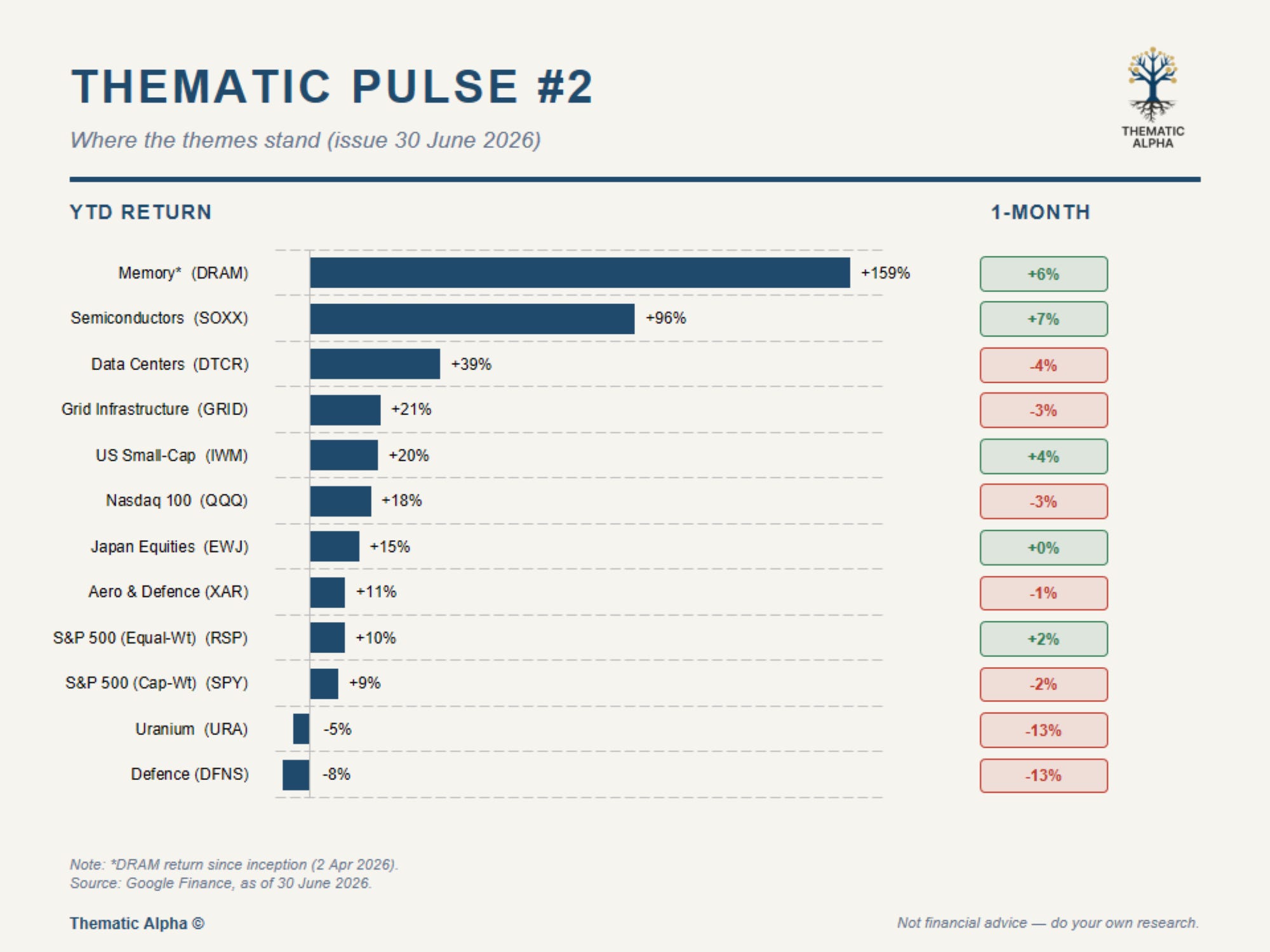
Compute. Memory stayed the strongest theme on the board. Memory is the standout, and Micron’s results on the 24th made the case in numbers, ahead of expectations on every line:
Revenue of $41.5bn, a record, versus about $35.7bn expected, a 16% beat.
Non-GAAP earnings of $25.11 a share, against roughly $20.50 expected.
Guidance for the current quarter of around $50bn, well above the ~$44bn the Street had pencilled in.
High-bandwidth memory already sold out for all of 2026.
The stock jumped about 16% the next day to an all-time high, and dragged the rest of the memory complex up with it, with SK Hynix, Samsung and SanDisk all rising sharply. Micron now carries the largest weight in the SOXX (around 9%), overtaking AMD and Nvidia. The wider chip complex was choppier: semis are about as high-beta as the market gets, and they swung all month on shifting rate expectations and the risk-on, risk-off headlines out of Iran. Broadcom was the clearest case, a strong quarter but a soft guide on its AI business set off a sharp early-June sell-off, and the stock is still recovering, trading around 20% lower over the past month. For comparison, Nvidia and AMD held up a little better, though still only in the barely-positive-to-negative single digits over the same window. One flag to keep in view: Bank of America’s June survey found a record 80% of managers call long semiconductors the most crowded trade on the Street.
Grid and power. The bottleneck behind the headlines. Most of the AI attention goes to chips, but the harder constraint sits a layer down, in the power and grid the build-out runs on. The signals are blunt: the US grid operators keep revising demand up, a large transformer now takes around two and a half years to deliver (some orders four), and the queue of projects waiting to connect to the grid runs far ahead of the new supply coming online. Chips can be manufactured in a couple of years and may ease; power is slower to fix and takes years to clear, which is what makes this a multi-year theme rather than a trade. It also isn’t only an AI story, since a big part of the spend is simply replacing an ageing grid, layered with electrification and reshoring. This is exactly the layer BlackRock singled out as the lower-volatility way to own AI, and it’s one of the structural legs I set out in the AI deep dive earlier this year. One sign of how binding the constraint has become: some hyperscalers need their data centres live so fast that they’re increasingly going “behind the meter”, building their own on-site generation (often gas turbines) to power the site directly and skip the multi-year wait to connect to the grid. It’s a near-term bridge, though, and the parties broadly converge that the more reliable, sustainable long-term answer is nuclear, which is part of why so much capital is pointing that way even though the reactors take years to arrive.
Uranium. Soft on spot and rates, structural case intact. Uranium had a soft month on the board, weighed by a spot price stuck in the mid-$80s and the same “higher for longer” rate worry that pressures every long-duration, capital-heavy theme. But here’s the distinction that matters: spot gets the headlines, while utilities actually fuel reactors on long-term contracts, and that’s a different, firmer market. Cameco’s president made the point bluntly this month, noting most of the volumes it contracted in 2025 were already priced in the three figures, around $120 a pound, and calling the spot quote the equities react to “yesterday’s price.” So the screen is red and the spot tape is soft, while the people signing the actual fuel contracts are working off something near $120. Under that soft tape, meanwhile, came a run of notable announcements that reinforce the longer-term structural case:
In the US, the Department of Energy committed up to $17.5bn toward as many as ten new reactors, alongside an enrichment-capacity expansion and a domestic fuel-supply deal for advanced reactors.
Canada launched a national nuclear strategy, targeting up to ten new reactors and a doubling of its uranium exports over the next decade.
India, on a longer fuse, opened its nuclear sector to private capital, behind a target of 100 gigawatts by 2047.
Meanwhile the equities have de-rated, with the uranium ETF about 30% below its January high. I already hold this one and treat the volatility as temporary; but if I didn’t, these are the kind of levels that might be interesting to start a longer-term position, if you like the structural thesis. In a world where governments and companies are increasingly focused on energy security and independence, nuclear is the route many countries are already taking, and the reactor build-out and restarts take time.
Defence and space. Share prices cooled, the spending didn’t. A soft month, with the prices and the politics pulling in opposite directions. On the share-price side: the Middle East de-escalation took some heat out of defence names, the SpaceX listing pulled capital away from the smaller listed space stocks, and Europe’s two flagship Franco-German programmes both cracked in the same month, the FCAS next-generation fighter (an Airbus-versus-Dassault fight over workshare and intellectual property) and, weeks later, wobbles in the MGCS battle-tank project that Rheinmetall is part of. Even the best-known name in European rearmament, Rheinmetall, is down around 40% on the year despite a record order backlog, and almost 15% over the past five days following the news.
But look past the day-to-day price action and the spending only gets bigger. Europe’s new joint defence-loan programme is sized at €150bn, part of a wider “ReArm Europe” push worth over €800bn; NATO has agreed a path toward 5% of GDP; Germany is lifting its own budget sharply; and in the US the primes keep winning, with Lockheed landing a missile-defence award worth up to $35bn in late June. Bottom line: if you think the world is drifting away from globalisation rather than back toward it, then strategic, sovereign capabilities, defence chief among them, become a structural, multi-year hold. Budgets on both sides of the Atlantic, and in Japan too, are being treated as close to non-negotiable.
Japan. A strong story, watching the yen. With the structural story for Japanese equities still intact, the yen is approaching a forty-year low past 161. The driver has shifted from last month’s energy-import drag to the interest-rate gap: even after the Bank of Japan raised to 1.00%, Japanese rates sit so far below US rates that traders keep borrowing cheap yen to buy higher-yielding currencies elsewhere, which keeps the yen under pressure. You can see it in the two versions of the ETF: year-to-date, the yen-hedged version (HEWJ) is running well ahead of the unhedged one (EWJ), around 21% versus 15%, precisely because the weak yen quietly clips the unhedged return. For the index itself, the historically weak yen is actually a tailwind, since it inflates the overseas earnings of Japan’s big exporters and has helped carry the Topix to fresh highs; the catch is the reverse, a sharp yen rebound would unwind a very large carry trade and hit those same exporters at once. Worth remembering, too, that Japan is the rare market where a central bank raising rates is good news, not a warning: it signals wages and prices finally rising together after thirty years, a central bank tightening out of strength. The structural case I set out in the Japan deep dive a couple of weeks ago, reform, the capex cycle, the slow shift of household savings into equities, hasn’t changed. The currency is just the thing sitting in front of it, worth paying attention to when choosing your currency exposure.
Breadth. The quiet winner: the rest of the market is catching up. The lazy read is that this is a narrow, mega-cap-led market. In 2026 it simply isn’t, and the board makes the point: the equal-weighted S&P (RSP, +10.5% on the year) is now ahead of the cap-weighted one (SPY, +8.5%), and small caps (IWM, +20%) have left the Nasdaq (+18%) behind, one of the best showings of any line on the scorecard. The Magnificent Seven, by contrast, are negative for the year as a group (around −3%), dragged by Microsoft, Meta and Tesla. Leadership has rotated from the famous seven to the suppliers underneath them, the enablers, the memory and chip and power names that sell into the build-out, rather than the hyperscalers writing the cheques. The honest caveat is quality: roughly 40% of the small-cap index is unprofitable, so it isn’t all healthy. But the broadening is increasingly backed by fundamentals, not just hope, with Goldman noting that mega-cap tech’s return on equity is now rolling over while the rest of the index grinds its returns higher. It’s the reverse of late last year: rather than a market carried by seven names, the rest is slowly starting to catch up. That’s a healthier backdrop, not a more fragile one, and it’s another point worth keeping in mind whenever the bubble debate flares up.
The one-line read
The board didn’t move so much as the ground under it did. The AI build-out still leads, but the leadership has quietly broadened, from the famous seven names to the suppliers underneath them and to the median stock, and it now does that leading in a world where rates have stopped falling. The softer themes, uranium and parts of defence, each have a clear near-term reason and a long-term case that is intact. As always, the themes worth the closest watch are the ones moving fastest, not the ones pausing.
What’s worth watching from here
The quiet half of the year is about to get loud, and there are two key things to watch ahead.
Earnings season, from mid-July. This is the real test of whether the market’s strength is justified. The banks kick it off on the 14th, the same morning as the June inflation print, but the ones that count for this board are the big cloud players and the chip and memory names in late July. Their results, and above all their spending plans, are the cleanest read on whether the AI build-out keeps compounding or starts to cool, and on whether the broader market’s strength holds.
The Fed, 29 July. Warsh’s second meeting, and the first real look at how the new, less-guided Fed behaves once the data has moved. With cuts now priced out, the risk sits on the hawkish side.
(Also on the calendar: the defence primes report 21 July, the Bank of Japan meets 31 July, and the Israel and Iran ceasefire window lapses in mid-August. Worth a glance, none likely to be the main event.)
Coming up: the next deep dive turns from the themes themselves to how you actually own them. Why I express these ideas through ETFs rather than single stocks, and how to tell a good thematic ETF from a bad one. Alongside it, I’ll be starting a few shorter, educational pieces, beginning with how to think about valuation in public markets, including from the lens of a practitioner in the investment banking industry, what the multiples do and don’t tell you, since that question sits underneath almost everything on this board.
If there’s a theme you’d like me to track or write about, the comments are open. And if you know someone who’d enjoy this kind of thematic work, sharing the newsletter with them is hugely appreciated, it’s the main way this grows.
Have a good week, all.
Best, Oliver.
Disclaimer: This is not investment advice, and you should do your own research. This reflects my own thinking; individual circumstances differ.