

The Mid-Year Map
Themes to think about when positioning a portfolio for the second half.

With the US printing new highs selling off today (for those watching it closely, stay strong), it felt useful to step back and look at how things sit on a more global scale — not just what’s working, but where the people who do this full-time are actually pointing.
Halfway through a turbulent year, the useful question isn’t “what’s the target for December” — it’s where institutional thinking stands. Most of the major houses have set out their thinking on the recent quarter and 6-12 months ahead, and the headlines flatten each one into a single number for the S&P. That’s the least durable part. The variables that matter now are moving underneath those numbers: a Middle East conflict that pushed oil sharply higher, inflation that has come back, a change of leadership at the Fed and US midterms ahead. What’s worth mapping is the conviction behind the calls and not only in the US, but across key regions.
Let’s look at the headline numbers for the US market first. Two takeaways after a volatile first half:
The regime has shifted. The tidy late-2025 consensus — soft landing, steady Fed cuts, a weaker dollar — has been overtaken. The oil shock put inflation back on the table, and the Fed has now held steady three meetings running. Several houses — among them J.P. Morgan, PIMCO and Apollo — have moved to a “higher-for-longer” view, some pricing no cuts at all this year.
The story is being rewritten in real time. Forecasts are moving faster than usual, and unevenly — some houses keep nudging targets up to meet the market, others cut once and left them.
Below is the distribution for the largest houses.
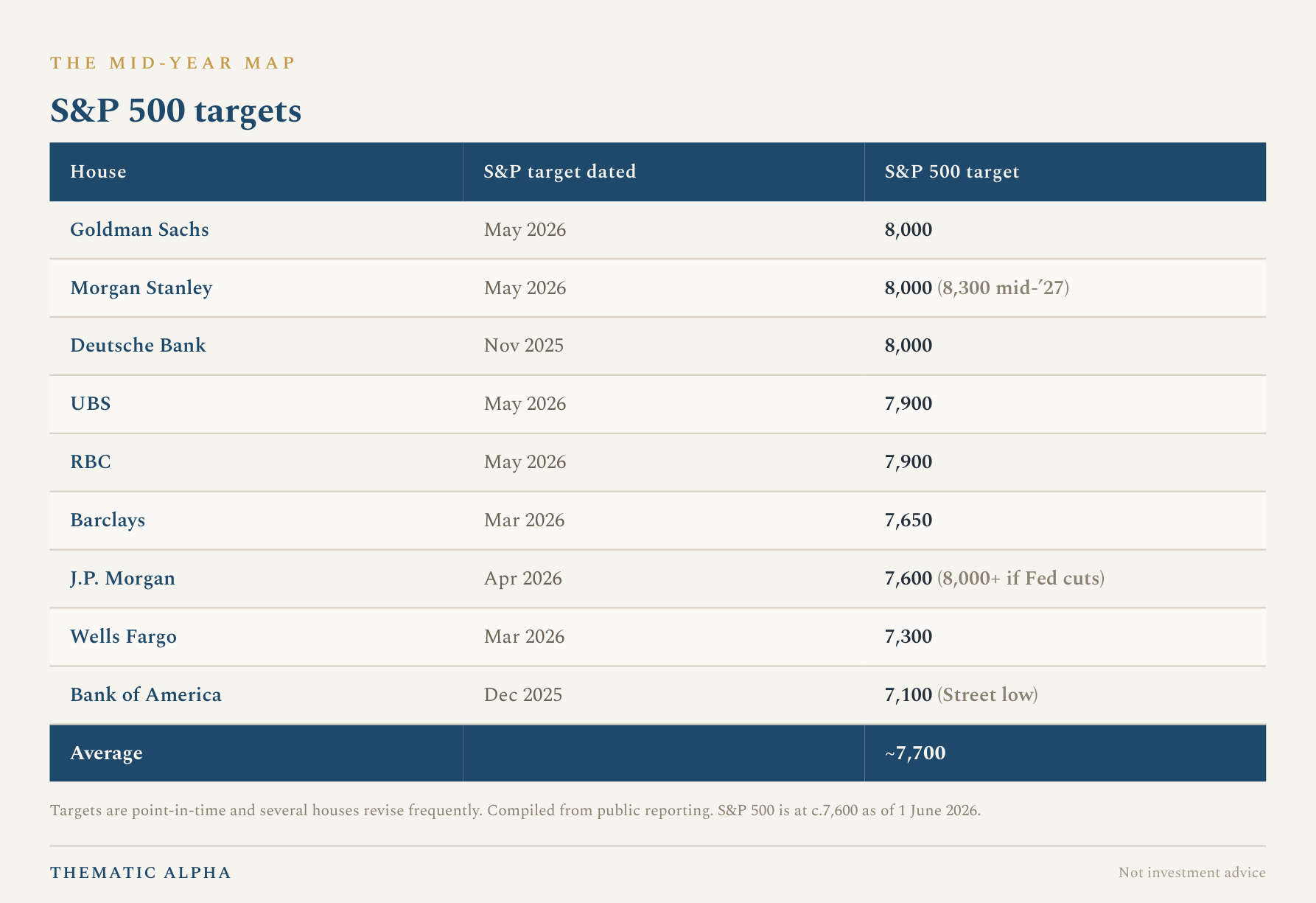
The unevenness is the tell. Wells Fargo cut its target in late March, on the war, and hasn’t moved it since — it now sits below where the market trades, even as the parts of the market it was wary of, chips especially, ran hard (and sold off sharply today after the jobs report). UBS has revised three times this year. The lesson isn’t whose number is right; it’s that the number is the least durable thing a house publishes. Based on close price as of 29 May (date for the market data), that implies a rather limited upside if we’re being honest (yes, slightly more if you’re looking at it today).
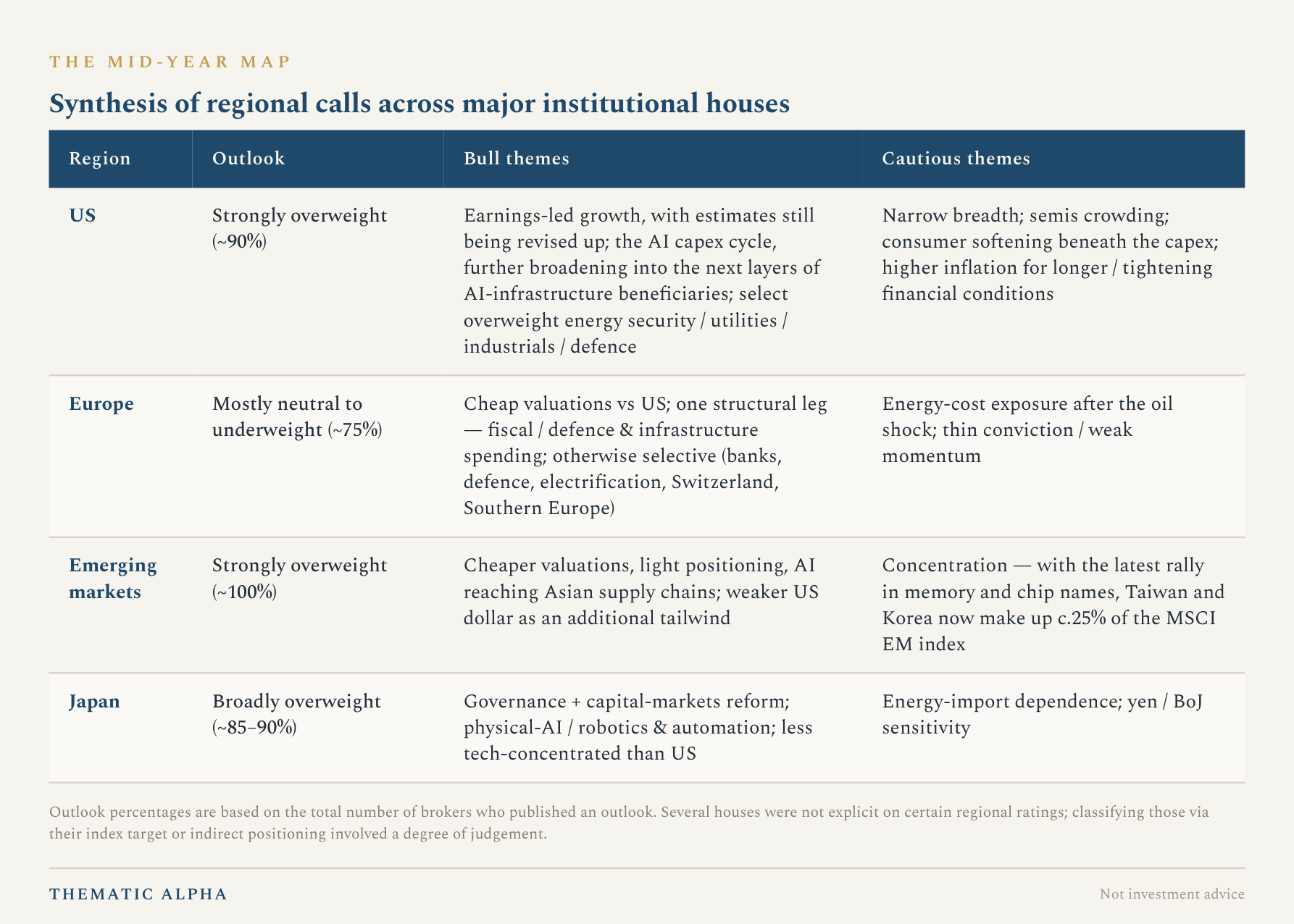
Now let’s look at the conviction underneath the headline numbers for the US and how this compares to other global regions (Europe, EM and Japan). Then we’ll dive into each of the regions in more detail.
United States — agreement on direction, argument underneath
Of the houses that take an explicit regional stance, nearly all are overweight or favour US equities — HSBC, having trimmed, is the lone step back to neutral. The reasoning splits into three sub-narratives.
Earnings, not multiples. Most frame the bull case as a profits story. Morgan Stanley frames it most plainly — in its telling, this is an earnings story rather than a multiple-expansion one. A dozen houses land in a $320–340 earnings band, growth north of 20%, and — the signal that matters more than any single figure — estimates have been holding or getting revised up into the season rather than cut. So the targets span 7,100 to 8,000 while the earnings assumptions sit in a narrow band: the real disagreement isn’t about profits, but about the multiple you’ll pay for them.
The AI build-out. The sourced, current idea is broadening — staying long the megacap AI names while extending exposure into the physical enablers: power, grid, data centres, the industrials around them. State Street’s midyear outlook urges investors to position beyond US large-cap tech for the next wave of AI; J.P. Morgan’s Private Bank points clients toward the data-centre build-out beneficiaries. The contrary note comes from BNP Paribas, which questions whether AI’s productivity gains are a genuine step-change or merely heavier use of existing tools — if the latter, some of today’s capex is front-loading returns rather than expanding them.
Breadth. Whether the rally widens further is genuinely unresolved — and worth being precise about. It did widen early in the year: equal-weight index outran the megacaps through February and March. Then it reversed. Over the past month mega-cap tech (incl. chips names) reasserted hard leadership, equal-weight lagged, and Goldman now flags breadth near its narrowest since the dot-com era. So the houses split. Citi has carried the broadening flag since its December outlook — its “Great Broadening” thesis, reaffirmed in April, holds that the non-Mag-7 names take on more of the earnings load — and Morgan Stanley has been overweight small-caps since November. Against them, Bank of America’s May survey shows the crowd jammed into one trade (long semiconductors was the most crowded position for some 73% of managers), and Apollo’s Torsten Slok keeps pointing at concentration: the top ten stocks are roughly 40% of the index, heading toward half when the big private AI names go public, which makes an index fund quietly a single-theme bet. RBC’s Lori Calvasina sits on the hinge with a “two-speed market” — AI in the fast lane, she says, the geopolitics in the slow lane. Broadening is the hope; and after today’s sell-off, equal-weight S&P 500 return is even ahead of S&P 500 YTD (7.8% vs. 7.6%). And S&P 600 (small caps) still holds a solid c.13% return. We’ll be monitoring how breadth develops.
Europe — where conviction is thinnest
Europe is the one region with consensus split across overweight / neutral and underweight, and that itself is the finding. Hardly any house is outright positive on the index: most sit neutral or underweight on the Eurozone — UBS reserves its only “attractive” for Switzerland; HSBC favours pockets of Southern Europe but stays neutral on the bloc. The clearest bull is BNP Paribas, overweight Europe and drawn to the “strategic-autonomy” winners — defence, banks, electrification — with Deutsche Bank constructive alongside it. Against them, a cautious camp — J.P. Morgan, State Street, Morgan Stanley — keeps returning to Europe’s exposure to energy costs after the oil shock; J.P. Morgan says it limits European exposure given its greater sensitivity to energy dynamics. The flat headline index masks real outperformers in those favoured sectors — but as a region, Europe attracts more caution than enthusiasm.
Emerging markets — where conviction is strongest
EM is where the houses are most aligned on the upside: of those with a view, essentially all are overweight — none neutral, none underweight. BlackRock captures the prevailing logic — overweight, but selective, favouring the Asian markets that make critical AI components and Latin American energy and commodity exporters. The shared case is cheaper valuations, lighter positioning, and the AI build-out reaching Asian supply chains. Two honest caveats sit underneath the enthusiasm. The first is concentration: this is, to a first approximation, an AI-hardware bet — Taiwan and Korea’s big chipmakers are roughly a quarter of the EM index, so the EM index might carry a portion of the same AI-cycle risk as the US, just wearing a different label. The second is the dollar: almost every bull case assumes it weakens, and it hasn’t — that presents a further tailwind if the Fed decides to ease. Worth separating what often gets blurred, too: EM, Asia-ex-Japan and Japan are distinct calls in most house frameworks — and it’s broad EM, led by North Asia, that the field singles out. It’s the clearest case of the houses pointing outside the US.
Japan — a structural case
The bull case is unusually well-rounded. The structural core is reform. Governance changes are pushing companies toward a more efficient approach to growth and capital allocation; dividends and buybacks have risen 2.5x since 2020 (per Morgan Stanley), a meaningful break from the past, and the scope for reforms is still widening. And there's a larger lever behind it: Japanese households still hold around half their wealth, roughly $7 trillion, in bank deposits — so even a gradual shift into equities would move the market, and policy is nudging exactly that. On top of that sits a more thematic leg the houses increasingly flag: Japan as a physical-AI play — Citi calls robotics and automation “nearing a commercial inflection point,” with Japanese equipment makers benefiting both from a labour-shortage automation push at home and from supplying the global AI build-out. And because Japan’s market is far less concentrated in a handful of megacaps than the US, it reads as genuine diversification rather than another way to own the same theme.
The honest risk is specific, and it’s not a positioning reading — it’s energy. Japan imports nearly all of it. The Bank of Japan’s own April outlook warns that higher crude, much of it from the Middle East, worsens Japan’s terms of trade and pushes down both corporate profits and household real income; a weaker yen sharpens the same import-cost problem. So the structural case is strong, but it comes with an asterisk (energy dependence).
The so-what and where I land
A quick look at how the regions have actually done puts the house views in context (YTD the return numbers will look smaller after today’s close, but the data below is more for comparison purposes and up-to-date as of end of last week):
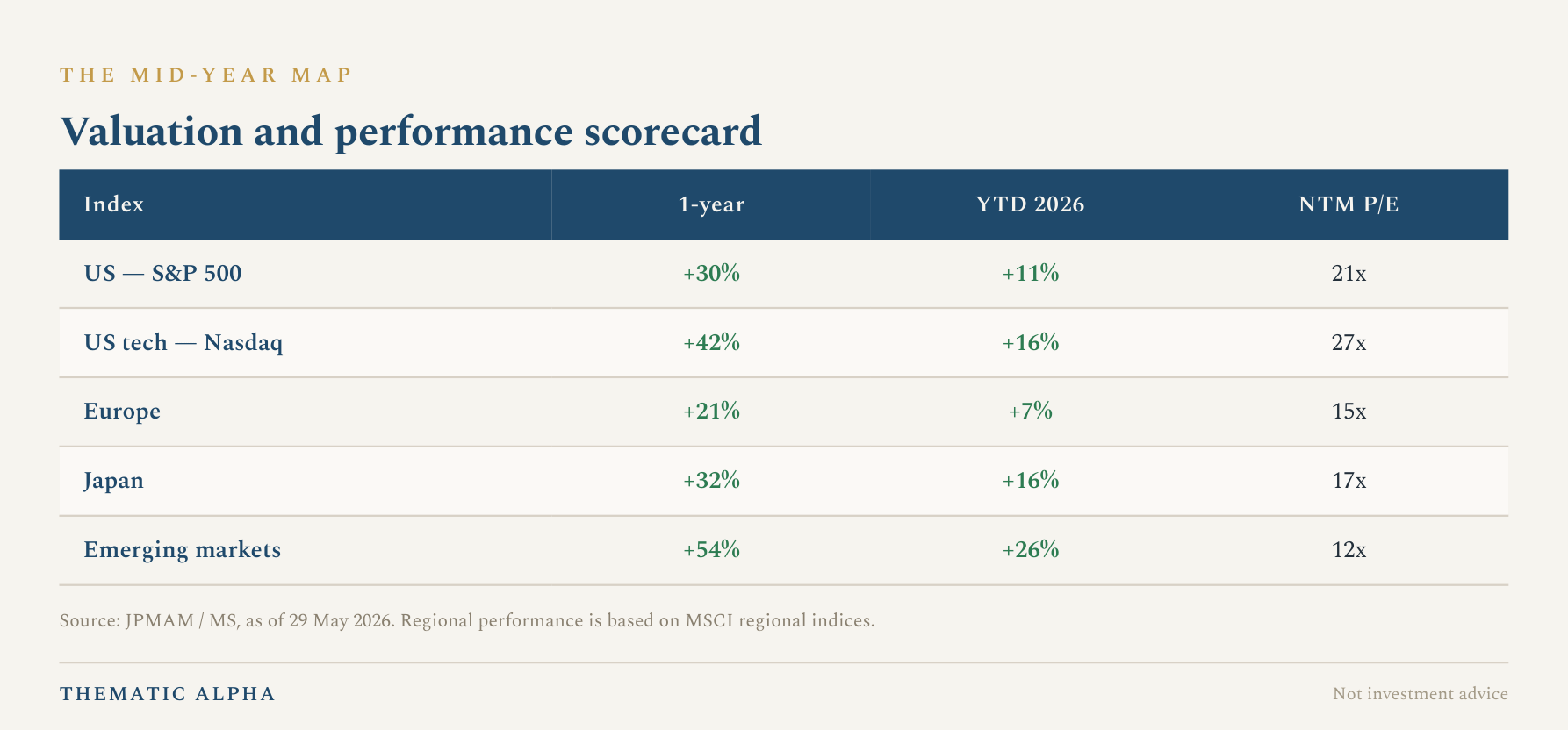
The striking part is that the diversification trade has already paid: emerging markets and Japan have outrun the broad US index (S&P 500) over both windows, even as the US makes the headlines with new highs. And the valuations line up with the story — EM is both the cheapest and the best-performing (but again, partially thanks to AI-related memory trade), while the US, and the Nasdaq especially, carry the richest multiples.
The consensus is clear enough — overweight the US, and for good reason; the earnings are real and the leadership has been relentless. It rarely pays to bet against America, and the people calling a top have mostly been calling it for a while. But for anyone who looks at their portfolio and sees mostly US mega-cap tech, the houses are near-unanimous that the diversification sits abroad — in emerging markets and Japan especially, the latter offering a structural-growth story that doesn’t ride on a single theme.
A genuinely personal note, to close — none of it a recommendation. I hold real conviction in the AI-infrastructure build-out broadening out from the chips into grid, power and, further out, uranium — but I hold it as a multi-year position, and I’d rather be honest about that than pretend it’s a this-quarter trade. I also think the S&P 493 has a real catch-up in it if the market rotates off this year’s narrow winners — which several houses also expect over time. And earlier this year I allocated a smaller portion of the portfolio (up to 10%) to emerging-markets-ex-China and Japan — not as a call against the US, just because concentration might be a risk whatever it’s concentrated in. That's the common thread: the houses can argue the targets; the discipline is in not mistaking the loudest part of the market for the whole of it.
Have a nice weekend all and stay tuned.
Best,
Oliver.
Disclaimer: This is not investment advice, and you should do your own research. This reflects my own thinking; individual circumstances differ.