

Japan, Finally
Why thirty years of deflation ending makes a structural case for Japanese equities — not just a this-quarter trade.

First, a quick orientation
A fair few of you have joined over the last couple of weeks — welcome, and thank you for being here. If you’ve just arrived, a quick orientation before today’s piece.
Thematic Alpha is where I think out loud about investing around big structural themes — the shifts that play out over years rather than quarters — and how to express them cleanly via ETFs, without pretending anyone can pick the single winning stock.
If you’re after a place to start, the two posts I opened with are the foundation: one on why I focus on themes in the first place, and one on portfolio thinking. From there, a few that build the picture — the deep dive into the AI trade, the running list of themes I’m tracking (the Thematic Pulse), and the rules I try to invest by. Last week’s Mid-Year Map then steps back to where the big institutions stand across global markets.
Today’s piece zooms in on one of that map’s angles: Japan. Less a case for diversification for its own sake, more a structurally attractive story worth knowing — especially if you’re starting to feel over-exposed to the same handful of US names everyone owns.
What this covers: the case for Japan in four legs — corporate reform, automation and capex, corporate cash, and the household cash shift — and the one risk worth watching: energy.
When I wrote the Mid-Year Map a few days ago, Japan was the region where the big institutions agreed most. Of the houses that took an explicit view, most favoured it — UBS, Morgan Stanley, HSBC, Goldman, Deutsche. They argue about Europe and they argue about how far the US rally can widen, but on Japan the field mostly points one way.
That kind of consensus should make a disciplined investor slightly uneasy, not reassured. Japan has been the great frustration of global investing for three decades: its market spent roughly thirty-five years below the peak it set in 1989, through several partial recoveries that never quite stuck, and only reclaimed that high in the last couple of years. The most recent run, since 2013, has actually had legs — but the long history of false starts (the Koizumi rally of the mid-2000s, which the financial crisis swallowed, is the cleanest example) is exactly why the honest question isn’t whether everyone’s bullish — they are — but why, and whether the reasons are durable this time. This piece walks the case leg by leg, then spends real time on the one risk that threatens it.
One principle before we start. None of what follows is a call on where the market goes this month. A stretch of price action tells you about sentiment; it tells you almost nothing about whether the structure underneath is changing. This whole piece is about the structure. Keeping the two apart is the point.
The frame: a thirty-year deflation is ending
Start with the history, because it’s the whole reason this matters. For most of the last thirty years Japan was trapped in deflation — a long grind of flat-to-falling prices. It sounds harmless; it isn’t. When prices don’t rise, companies don’t dare lift them, so they can’t raise wages; workers who expect no pay rise don’t spend; and households sit in cash, because when prices fall, cash quietly gains value doing nothing. The whole system learns to wait, not spend. The market reflected it — those three-plus decades stuck below the 1989 high.
The strange part is that near-zero interest rates never fixed it. The clearest explanation comes from Richard Koo, the long-serving chief economist at Nomura Research Institute: after a debt-fuelled asset bubble bursts, companies spend years paying down debt rather than borrowing to invest — even at zero rates — so the cheap money never turns into demand (his term is a “balance-sheet recession”), and only government spending fills the hole. An ageing, shrinking population kept demand soft on top of that.
What’s changed is that the key economic signals now point, for the first time in a generation, in the same direction — up. The evidence shows up in three places: wages, growth, and government policy. Take them in turn.
Wages
Wages are the clearest tell, but you have to read them carefully, because two different numbers get confused constantly. The headline you see in the press is the shunto — Japan’s annual spring round of pay bargaining between big firms and their unions. That has delivered increases of around 5% three years running: 5.10% in 2024, 5.25% in 2025, and about 5.26% in the first 2026 tally (still preliminary; the final figure lands in July). That’s the strongest run since the early-1990s bubble. But the shunto only covers workers at large, unionised firms. Spread across the whole workforce — smaller firms, non-union staff — actual pay growth has been more like 1.5–3%.
For most of the past few years that wasn’t enough, because prices were rising about as fast — inflation ran ~2.7% in 2024 and over 3% in 2025 — so real wages, pay after inflation, were actually falling, every single month of 2025. That finally flipped at the start of 2026: real wages turned positive in January (+1.4%) and again in February (+1.9%), the first back-to-back gains in over a year.
Here’s why that one flip matters more than any other number in this piece. When real pay is rising, households can finally spend a little more without falling behind — which lets companies raise prices and grow their sales in yen, which lets them pay a little more again. That virtuous circle, ordinary in most economies, is the domestic demand engine Japan has been missing for thirty years. It doesn’t make the case on its own — but it’s the backdrop that makes the four legs below possible.
Economic Growth
The wage story sits on top of a bigger shift in the size of the economy — and one quick distinction makes it click. Nominal GDP is the economy measured in plain yen; real GDP strips price changes out to show the actual volume of goods and services produced. For a generation Japan’s nominal GDP barely grew even when real output edged higher, because falling prices kept dragging the yen figure back down (the “deflator” was negative). That’s now reversed: nominal GDP hit a record ¥662.8 trillion in the last fiscal year, up 4.5% and rising for a fifth straight year, while real output still grew at about a 1.8% annual pace in the first quarter of 2026. After decades of standing still in yen terms, that hands companies something they hadn’t had: room to raise prices and grow sales.
Government policy
The third leg is a push from the top. Japan’s government under Prime Minister Sanae Takaichi, who took office in late 2025, has leaned firmly pro-growth: a roughly ¥21 trillion fiscal stimulus package compiled in November 2025, and a state-backed investment drive across seventeen “strategic” sectors — among them semiconductors, AI and robotics, defence and space. Defence spending alone has been pushed to a record ¥9 trillion, hitting the 2%-of-GDP mark years ahead of plan. You don’t have to love the politics to see the market consequence: an activist, spend-to-grow government is one more tailwind under the story — and, as the second leg shows, it aims the money straight at the industries Japan is strong in.
Putting it together — the central bank
The clearest sign all this is real is that the Bank of Japan is acting on it. It increased its policy rate to 0.75% late last year — a level unseen in three decades — paused through the spring while the oil shock clouded the picture, but is expected to start raising again at its mid-June meeting. The distinction worth drawing is why. Other central banks are also moving — the European Central Bank raised in June, the US Fed is on hold and might lean hawkish — but they’re fighting unwelcome, oil-driven inflation. Japan is the one major economy tightening for a good reason: wages and prices feeding each other at last. Goldman makes the sharper point — in most markets rising rates weigh on shares, but in Japan normalisation is a positive, because it hands the central bank back the room to cut if a downturn ever comes, optionality it hasn’t had in years.
One honest caveat. The very latest inflation prints are actually soft: core inflation — the Bank’s preferred gauge, which strips out volatile fresh food — fell to about 1.4% in April, below the 2% target. But that’s because government energy subsidies are temporarily holding prices down; the Bank expects it to reverse and has raised its core forecast for this year to around 2.8%. So “inflation is hot” is wrong, and so is “inflation is fading.” What’s durable is the bigger thing: the deflationary regime — the thirty-year psychology of falling prices and hoarded cash — looks structurally over.
And that is why this matters for the stock market. A company that can finally raise prices, grow its sales in yen and pay rising wages without going backwards is the one whose profits can compound — the soil equity returns actually grow in. Japan didn’t have that for thirty years. On the evidence, it does now. The four legs below are how it turns into returns.
Leg one — companies are starting to put shareholders first
The first leg is corporate reform, and the heart of it is simple: Japanese companies are being pushed to run themselves for their owners — to use capital efficiently and answer for the returns they earn — after decades of not really bothering. Here’s the mechanism behind it.
In 2023 the Tokyo Stock Exchange did something unusually blunt. It began publicly pressing any company that traded below its “book value” to publish a plan to fix it — or sit on a named list of those who hadn’t. Trading below book value means the market valued the whole company at less than the stated worth of its net assets: a quiet verdict that investors expected management to do nothing useful with the cash and assets they held. In a culture as consensus-driven and reputation-conscious as corporate Japan’s, being named on that list is a real lever.
It has moved the numbers. Among companies in the exchange’s top “Prime” tier, the share trading below book value has fallen from roughly 43% in 2022 to around 27% by 2025, and the large majority now publish the improvement plans the exchange asked for (figures per the JPX, via a Harvard governance review, October 2025). The reform is still deepening: the latest revision of Japan’s corporate-governance code — a draft published in February 2026, now being phased in — pushes companies further toward putting idle cash to work.
Now the honest tension, and it’s worth getting right, because it’s the crux of the whole trade. The profitability of these companies is improving, but from a low base: return on equity (ROE) — profit measured against the shareholders’ money tied up in the business — for the broad Topix is now about 9% (9.1% as of March 2026), up from the 6–8% that prevailed a decade ago, when it sat below the 8% floor a landmark government review (the Ito Review) urged companies to clear. That’s real progress — and it’s not just optics: Citi puts Japanese corporate profits at 18.2% of GDP at the end of 2025, up from 13% in 2019 and around 8% a decade earlier. But Japanese ROE is still only about half the ~17% US companies earn — which is exactly the bulls’ point: the gap is the runway.
If you want one outside vote of confidence, it’s a familiar name. Berkshire Hathaway began buying Japan’s five big trading houses in 2020 and has kept adding — it crossed above 10% in all five this year, passing the threshold in the last two, Sumitomo and Marubeni, in May, for a holding worth around $35 billion by the end of last year. This was Warren Buffett’s conviction originally — the investor who’d once written Japan off for its low returns on equity — and his 2025 shareholder letter framed the stakes as near-permanent, noting the companies had agreed to let Berkshire move past the ownership ceiling it first accepted. With Buffett now handing the reins to Greg Abel, Berkshire has reaffirmed it intends to hold them for the long haul. That’s not proof the reform works, but it’s the most patient capital in the business betting that the change in how these companies treat their owners is durable.
Leg two — automation, reindustrialisation, and the parts Japan makes
The second leg is the most forward-looking. It’s Japan as a key supplier to a wave of corporate capital spending: companies investing in plant, equipment and technology, not government spending. Morgan Stanley puts Asia’s corporate capex rising from about $11 trillion a year today toward $16 trillion by 2030, with Japan’s slice climbing to around $1.7 trillion — driven by AI infrastructure, energy security and defence, most of it still ahead.
The cleanest way to own Japan’s automation strength, it turns out, isn’t the robots — it’s the parts inside them. Here’s the distinction that matters. On finished industrial robots, Japan is losing ground to cheaper Chinese makers (like Estun, Inovance), whose brands together took more than half of China's own domestic market for the first time in 2024. But a level deeper, Japan dominates the high-value components every robot needs — and sells them to the whole industry, Chinese assemblers included. Nabtesco makes roughly 60% of the world’s precision reduction gears for heavy robot joints; Harmonic Drive supplies around half the strain-wave gears used in lighter and humanoid joints; Keyence is one of the two global leaders in the machine-vision sensors that let a robot “see.” As automation grows worldwide — whoever screws the robots together — a lot of the value flows back to these Japanese parts makers.
Two honest caveats keep this from being a free lunch. First, the Chinese are starting to make those components themselves: domestic gear makers now supply a third or more of China’s home market at 40–60% lower prices, so Japan’s edge is narrowing toward the premium tier — precision, reliability, automotive-grade and the emerging humanoid market — rather than “everything.” Second, the bull case for these names has leaned partly on a US-reshoring rebound that’s real but partial: FANUC and Yaskawa are building new US plants to catch it, but the American market is smaller than the China share they’ve lost. So this is a premium-components story, not a “Japan wins automation outright” story.
What gives the leg real weight is a second, broader force: reindustrialisation. As the West de-risks its supply chains from China — which now makes ~28% of the world’s manufactured goods, more than the US, Japan and South Korea combined (Goldman’s figure) — Japan is, in Morgan Stanley’s words, “emerging as a preferred alternative for sensitive supply chains” and “a strategic industrial hub in a more fragmented global economy.” That “friend-shoring” pull reaches well beyond robots — into electrical equipment, electronics, shipbuilding, defence and critical materials — and it’s the kind of demand a cheaper rival can’t simply undercut on price, because half the point is not buying from China.
The home market reinforces it. Japan’s working-age population has fallen about 15% from its mid-1990s peak — and keeps shrinking, with a shortfall of some 11 million workers forecast by 2040. It is the strongest incentive in the developed world to automate — and the Bank of Japan itself now points to labour shortages driving investment in labour-saving kit. Takaichi’s strategic-investment list names AI and robotics outright. And the automation leaders are climbing the stack: at this year’s big AI-hardware conference, both FANUC and Yaskawa were named partners building their robots into Nvidia’s “physical AI” software — the tools that train and simulate robots before they reach the factory floor.
There’s an AI-infrastructure angle too, and it’s more concrete than it sounds. Japan has quietly become a magnet for data centres — some $26 billion of committed hyperscaler investment from Amazon, Microsoft and Oracle, with the country’s data-centre power demand forecast to roughly triple by 2034. That throws off demand for exactly the unglamorous kit Japan makes — grid gear, switchgear and power electronics from the likes of Hitachi and Mitsubishi Electric, plus reliable supply from the utilities. There’s an honest tension here — a country that imports ~84% of its energy leaning into one of the most power-hungry industries going — but it’s being met head-on: Japan is restarting its nuclear fleet (fifteen reactors now running), partly to feed this very demand, with one operator reportedly lining up data centres next to a restarted plant. (More on energy later — it’s the asterisk.)
Semiconductor reshoring sits alongside all this — TSMC is building advanced chip plants in Kumamoto, and the state-backed venture Rapidus is chasing leading-edge production — as Japan positions itself as the safer place to make sensitive things. The throughline: across robot components, reindustrialised supply chains, AI infrastructure and chips, Japan keeps showing up as the picks-and-shovels supplier rather than the headline name.
Leg three — corporate cash starts coming back to shareholders
A quick signpost, because the next two legs are both about cash piles: this one is the cash sitting inside Japanese companies; the next is the cash sitting in Japanese households. Different pools, different stories.
The clearest sign the reform is biting is what companies now do with their profits. For decades the instinct was to sit on them — to build enormous cash reserves, and to hold large “cross-shareholdings,” stakes in one another’s shares. That last habit needs explaining, because it’s peculiar to Japan. Companies held shares in their suppliers, customers and banks not to earn a return but to cement relationships and mutual loyalty — a legacy of the post-war “keiretsu” model, where stable business ties and protection from takeover mattered more than the return on the capital tied up. To an outside shareholder it’s dead money: billions parked in other firms’ stock to buy goodwill rather than profit. The returns-first thinking that’s the default in the US or UK simply wasn’t, for a long time, how corporate Japan operated.
That’s now breaking. Dividends and share buybacks together have risen about 2.5x since 2020, on Morgan Stanley’s count — a direct result of the governance pressure. The web of cross-shareholdings is being deliberately unwound, with 2025 setting records for the pace: reform-driven selling of those legacy stakes back into the open market — distinct from takeovers — often paired with a buyback to soak up the freed shares. Toyota alone launched a ¥1.2 trillion buyback partly to absorb stock from unwinding its cross-holdings, and Japan’s three big non-life insurers have pledged to shed cross-holdings worth around ¥9 trillion between them.
There’s far more that could follow, because the cash pile is genuinely unusual. Japanese companies hold cash and deposits worth around a tenth of their total assets — against roughly 6% in the US and 7–8% in Europe — and well over half of the larger listed companies carry net cash, meaning more cash than debt, a share several times higher than in the American or European markets. That’s dry powder for buybacks, dividends and investment that simply doesn’t sit on most developed-market balance sheets.
This is the leg I find most convincing, because behaviour is harder to fake than a disclosure. A company can write a plan to please the exchange. Actually buying back its shares, selling stakes it’s held for forty years, or spending record sums on takeovers costs real money and is hard to reverse — and corporate Japan did around $386 billion of mergers and acquisitions in 2025, an all-time high. That record is itself a reform outcome, not a coincidence: analysts at J.P. Morgan and Dealogic tie it directly to the governance push — activist pressure, the unwinding of cross-holdings, and boards now obliged to take takeover approaches seriously rather than swat them away. It’s the reform showing up as deals.
Leg four — the household cash starts to move
Now the slowest and largest lever, and this one is about households, not companies. Japanese households hold financial assets of roughly ¥2,300 trillion — on the order of $15 trillion — and, on Morgan Stanley’s framing, until very recently kept about half of it (some $7 trillion) sitting in bank deposits earning almost nothing. That’s the deflation hangover in a single statistic: when cash holds its value, there’s little reason to take the risk of owning shares.
That’s starting to shift. The share of household wealth held in cash has just dropped below 50% for the first time in eighteen years — to about 49%, on the Bank of Japan’s flow-of-funds data for late 2025. It’s a small-sounding move against a pool that size, which is exactly the point. And policy is pushing deliberately: a revamped tax-free investment account (”New NISA”), launched at the start of 2024, has already pulled retail equity flows past the government’s own 2027 target. Japanese households still hold only about 14% of their wealth in shares, against roughly 25% in Europe; Morgan Stanley’s arithmetic is that closing even part of that gap could move something like ¥270 trillion — about $1.7 trillion, or a fifth of the entire Prime market’s value — into stocks over time.
You don’t need a dramatic conversion for that to matter. A country whose households are gradually, structurally reallocating a slice of a $15-trillion cash pile toward equities has a home-grown source of demand that doesn’t depend on what foreign investors decide this quarter. It’s a slow tailwind, and slow tailwinds compound.
Why this is diversification, not just the same trade in disguise
A lot of what passes for diversification is the same bet wearing a different badge. Buy “emerging markets” and you’re mostly buying Taiwanese and Korean chipmakers; buy a “global” fund and it’s largely US megacap tech. The risk hides in the correlation — it only shows up when the one thing everyone owns falls together.
To be clear, I’m not bearish on the US. Betting against America has a famously poor record — as Buffett has long said, don’t bet against America — and my own core holdings are in the broad US market, not just the AI build-out. This isn’t a step back from any of that. It’s the other half of the same discipline: when one theme grows into your biggest position, you want something beside it that doesn’t rise and fall on the same headlines. Japan is the cleanest version of that I’ve found.
Japan is genuinely different, and the structure of its market shows it. It’s far less top-heavy: the ten largest stocks are around a fifth of the broad Topix index, against close to 40% for the S&P 500, and no single name is much above 4% of the index. Its biggest sector is old-fashioned industrials — about a quarter of the market — with financials and a domestically-tilted tech sector behind it. Set that against its neighbours and the contrast is sharper still: two chipmakers are more than half of Korea’s index, and a single company is over 40% of Taiwan’s index. Strip Korea and Taiwan out of this year’s emerging-market returns and the earnings-growth picture thins dramatically — the regional “AI rally” is, to a first approximation, a handful of chip names, a point that strategists have made. Japan, by contrast, gives you a broad spread — carmakers, banks, trading houses, industrials — alongside the build-out’s picks-and-shovels.
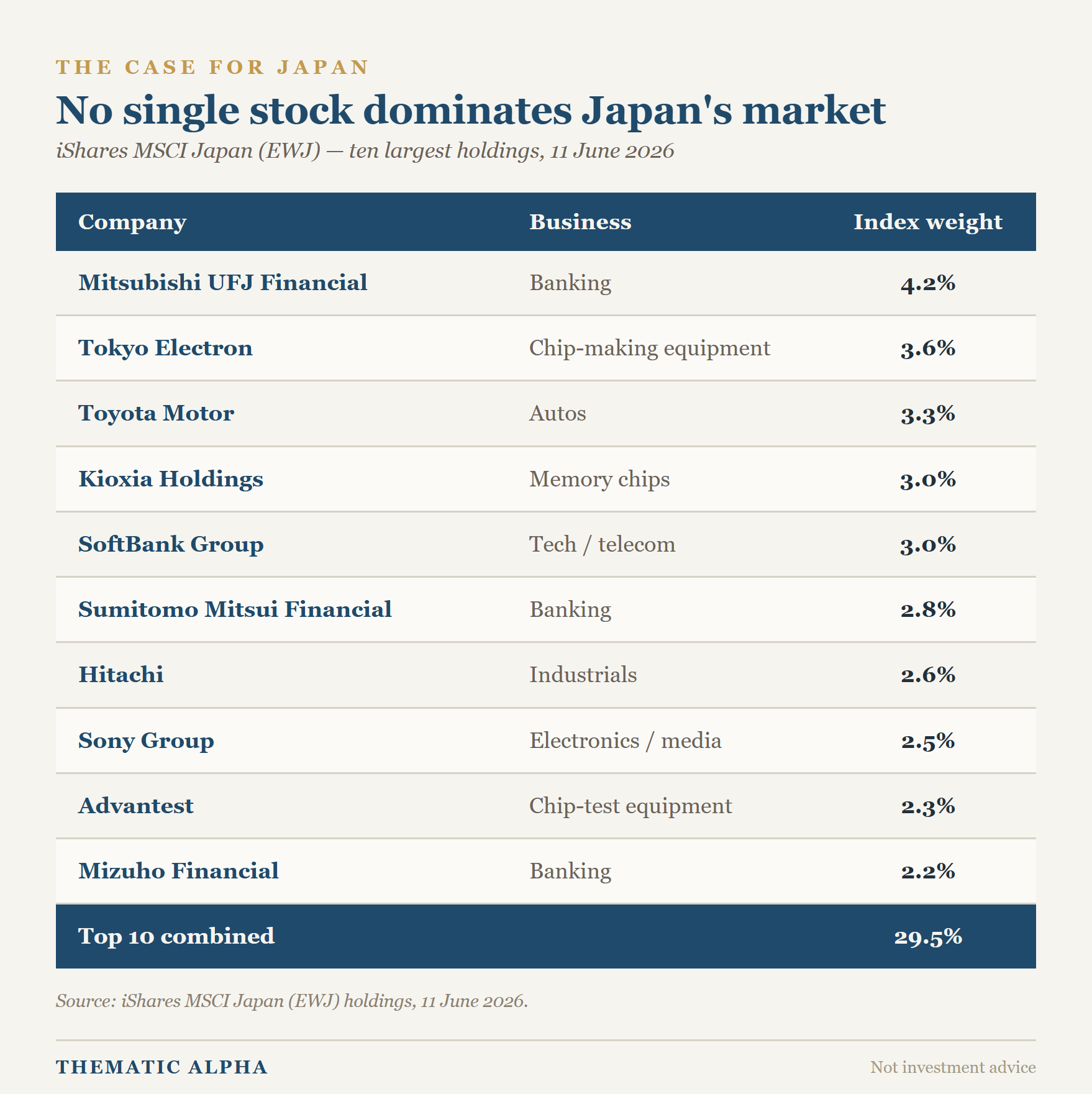
There’s a subtlety worth being honest about, because it cuts slightly against the “non-AI” framing. Japan isn’t anti-AI — it gains from the AI wave too, just through a different door: the physical layer, the robots, automation gear and data-centre power we met in the second leg, rather than the chips and cloud platforms at the centre of the US trade. So the pitch isn’t “own Japan instead of AI.” It’s that Japan is far less hostage to the AI-chip cycle while still sharing in its build-out — and is powered, on top of that, by a home-grown reform-and-reflation story the US trade doesn’t have. That’s a genuinely different engine, which is the whole reason to diversify.
It’s also cheaper. Japanese shares trade at roughly 15 times forward earnings against the US north of 21, and at under two times book — directional figures, but the gap is wide and persistent.
The asterisk — energy
Now the risk. It earns more than a footnote because it’s specific and real — but it’s a bump in the road, not a wall the case runs into. Japan makes very little of its own energy. It produces only about 16% of the energy it uses at home (the latest official figure, for the year to March 2025 — up from about 13% in 2022, as restarted nuclear plants help) and imports the other ~84%. Of its crude oil specifically, roughly 95% comes from the Middle East. On energy, Japan is almost wholly at the mercy of a price set abroad. In a calm world that’s a manageable footnote. In 2026, with conflict in the Middle East having pushed oil sharply higher, it bites.
The Bank of Japan said as much, plainly, in its April outlook. It expects growth to slow because corporate profits and household incomes are being squeezed by a worsening in Japan’s terms of trade — the balance between what the country earns for its exports and what it pays for its imports. Two things drag it the wrong way at once: the oil price has jumped, and the yen is unusually weak, which makes every imported barrel cost more in yen even before the oil-price rise. The Bank named the cause directly: Japan is, in its words, “highly dependent on crude oil produced in the Middle East.”
That reaches households fast. Energy and food make up about a third of the Japanese consumer-price basket — against a fifth in the US and a quarter in the Eurozone, on Citi’s March 2026 figures. The basket includes both food and energy — electricity, gas and petrol — and Japan imports most of both, so a higher oil price shows up quickly: in utility bills, at the pump, and on the price of imported food on the shelf. It’s why the government has leaned so hard on those energy subsidies — it’s trying to keep the shock off households.
The weak yen cuts both ways here. It’s a gift to Japan’s big exporters — and Japan exports a lot, around 22% of GDP — who earn in foreign currency and report profits back in cheaper yen; it’s part of why the headline market has done well. But the same weak yen makes every import more expensive and squeezes households and smaller domestic firms — the very households the reform story needs to coax into the market. The two effects don’t cancel; they pull in opposite directions, and which one wins turns on an oil price nobody controls.
How big is the growth hit? Use the Bank of Japan’s own number: it cut its forecast for this fiscal year’s real growth to about 0.5%, from 1.0%, citing the oil shock and the terms-of-trade squeeze. Growth slows, in other words, but stays positive. And Japan isn’t standing still on the underlying weakness: it’s restarting its nuclear fleet — fifteen reactors now back online, more in the pipeline — which is lifting energy self-sufficiency and is explicitly tied to powering the AI build-out, with energy security one of the government’s named strategic priorities. None of that makes the oil exposure vanish; it makes it a vulnerability Japan is actively managing rather than a static weakness. That’s why I call it a bump to watch, not a wall.
That’s the case and the asterisk. The structural argument — reform, automation, the cash coming back, the household shift — is about slow internal change Japan largely controls. The risk is an external price it doesn’t. The disciplined approach is simple to state: back the structural story, but keep a close eye on the oil risk.
How you might own it — and the yen question
A framework is only useful if it’s investable, so a few practical building blocks — theme-level, as always, not single names, and do your own research before acting.
The simplest expression is a broad Japan equity fund — iShares MSCI Japan (EWJ) in the US, or a Japan UCITS fund for UK readers — which holds the carmakers, banks, trading houses and the automation names in one wrapper. Worth knowing: a broad Japan fund already owns the robotics champions, so holding a separate robotics ETF on top (if you do) mostly doubles up the same names rather than adding much.
The one decision that’s specific to Japan is the yen. An unhedged fund gives you the shares plus whatever the currency does; a yen-hedged version (HEWJ, a hedged equivalent of EWJ, or IJPH for the UK) strips the currency out so you own the equities alone. With the yen near multi-decade lows that’s a real choice, not a technicality — and it ties straight back to the asterisk. If the yen stays weak, an unhedged dollar or sterling return gets dragged; if the Bank of Japan keeps raising rates and the yen recovers, unhedged becomes a tailwind. There’s no free answer — just make it a conscious choice rather than a default.
Where the numbers sit, and where I land
The diversification trade has paid off so far: EWJ (unhedged version) is about 14% up this year, HEWJ (hedged version) is ~18% up, both comfortably ahead of the S&P 500’s ~8%. In 2025 performance for EWJ / HEWJ / S&P 500 was 26% / 30% / 18% respectively.
Now, briefly, where the institutional houses sit on the Topix, the broad-market benchmark. The cautious year-ahead target set back in December — Daiwa’s 3,750 — has already been overtaken; the index, around 3,880 today, has run past it. Most of the rest sit above: BofA around 4,100 (a modest ~6% up), and the freshest, most bullish higher still — Goldman lifted its twelve-month target to 4,400 in June (~13% above today), Morgan Stanley’s base case is 4,300 (~11%). So the honest read is two-sided. The easy money — the gap to the conservative consensus — is gone; but the houses closest to the story still see double-digit upside. On Goldman’s own book that’s about 13% in Japan against roughly 8% left in the S&P — appreciably more, even after the run. Targets are directional, not promises — and I wouldn’t lean on any single one.
A word on earnings, since it’s the obvious question — and the answer doubles as the diversification point. On the broad consensus, Japanese companies are set to grow earnings around 13% this year. As recently as April that was line-ball with the US (~14%). What’s happened since is the tell: the US consensus has been revised up hard, into the low-20s%, while Japan’s held in the low-teens — and that jump is the AI and semiconductor mega-caps, not a broad-based American acceleration (at least not for now). Japan’s growth is lower today but more evenly spread, on a cheaper starting valuation, and arguably with more room to catch up. The case was never that Japan out-earns America; it’s that you get comparable, broader earnings without paying the same price — or carrying the same concentration.
A genuinely personal note to close, and none of it a recommendation. Earlier this year I moved a smaller slice of my own portfolio into emerging-markets-ex-China and Japan. Not as a bet against the US. I did it because concentration is a risk whatever it’s concentrated in, and Japan offered something most “diversifiers” don’t: a structural-growth story standing on several separate legs rather than riding the same AI wave.
I hold it as a multi-year position, and I’d rather say that plainly than dress it up as a this-quarter trade. The reform could stall; the energy bill could swamp the progress; the cheap valuation could simply stay cheap. But the thread that runs through everything I write applies here too: the houses can argue the targets, and a bad week can rattle the screen, but the discipline is in deciding what would actually break the thesis — and then sitting through the noise until it does. For Japan, the thing to watch isn’t the weekly price. It’s whether the cash keeps coming back to shareholders, whether households keep stepping off the sidelines — and what the oil price does to all of it.
Have a good weekend, all.
(and hope you’re enjoying the variety of sports events right now, be it tennis Grand Slam, NBA or NHL Stanley Cup finals or starting World Cup).
Best, Oliver.
Disclaimer: This is not investment advice, and you should do your own research. This reflects my own thinking; individual circumstances differ.
Japanese real estate is what is interesting for me